

The clearest AI automation examples right now are not chatbots answering questions, they are named systems doing a specific job end to end: a real estate brokerage’s agent scoring 11,000 leads every morning, a finance team’s Zap sorting a shared inbox into nine categories, a support queue that closes its own tickets. Zapier’s case roundup lists a residential brokerage called Rush Home running an agent named “Russ” that scores its lead database with Claude and emails each rep a ranked morning brief, built because the founder kept hitting CRMs with no trigger for what he needed. That is the shape every other example here follows: a specific task, a named tool, and a result you can point to.
AI Agents Examples: Named Systems, Not Demos
An agent example is worth trusting only when it names the tool, the task, and the outcome, not “AI helps teams work smarter.” Rush Home’s Russ is one. So is Otter’s triage agent: when Head of Customer Experience Allen Lai joined as a team of one, he built a Zap that reads the last comment on any reopened Zendesk ticket, runs it through ChatGPT for sentiment, and auto-closes anything that is just a customer saying thanks. That agent closed more than 1,000 tickets in its first three months, per Zapier. Remote runs a similar pattern on IT support: a three-person team fielding nearly 1,100 tickets a month built a help desk where ChatGPT classifies and prioritizes every request and suggests a resolution from past tickets, resolving 28 percent of the queue without a human touching it.
None of these are the generic “AI agent” a vendor slide promises. Each is scoped to one recurring decision and nothing else. That scoping is the difference we walk through in AI agents examples: an agent needs a loop, a toolbox, and memory that persists between runs. Strip any of the three out and you have a flowchart with an AI label stapled on.
Agentic AI Examples: Multi-Step, Not Multi-Prompt
Agentic gets used to describe two very different things, and only one deserves the word. A single prompt that drafts an email is not agentic no matter how good the model is. What earns the label is a chain where the system reads a result, decides what it means, and picks its own next action without a person choosing each step. BioRender’s accounts receivable team built exactly that: a 51-step Zap where Gemini reads every incoming ticket, sorts it into one of nine finance categories, checks live workload, and routes it to whoever can take it next. Zapier reports that cut ticket resolution time by 69 percent. Nobody wrote 51 steps because it looked impressive. A shared inbox with purchase orders, tax exemptions, and vendor registrations tangled together needed that many decision points to sort itself.
Appian draws a cleaner line than most vendors bother to: automation is the umbrella, and AI is the “cognitive automation” flavor of it, the kind that adapts to a new situation instead of running the same fixed rule every time. A rule that says “if invoice total matches PO, approve” is automation. A system that reads a slightly malformed invoice, decides it still matches the PO within reason, and flags only the genuine mismatches, that is agentic. Vendasta’s sales team proved the same pattern on revenue: reps were losing close to 300 working days a year to manual CRM updates, so a rebuilt Zap now enriches every lead, summarizes it, and turns each call transcript into logged notes and a drafted follow-up automatically. Zapier credits the rebuild with recovering roughly a million dollars leaking out through slow follow-up, four decisions in sequence, not one prompt doing one thing well.
Workflow Automation Examples: What n8n Actually Ships
n8n is worth naming because it was built around the node-and-agent model instead of a single chatbot window, and its site currently lists more than 12,000 community workflow templates. Volume matters less than what they contain: agent nodes sitting next to ordinary tool-call nodes for spreadsheets, Slack, and HTTP requests, so you can see which tool the agent called and why instead of taking its answer on faith. We cover that node model in more depth in workflow automation examples, including where n8n’s flexibility trades off against build time versus a simple Zap. The library of n8n workflow examples skews toward multi-step agent chains, which is the whole point of the platform.
The workflow automation examples that hold up share a pattern: they replace one specific multi-system handoff, not a whole department. Coworker’s roundup lists invoice processing and accounts payable as one of the most common builds, where automation extracts invoice data, validates it against purchase orders and receipts, and flags only the real discrepancies for a human. We built a version of that pattern for a payments client who needed higher-risk transactions escalated through a KYC check that still felt normal to the end user, not a system that stopped every transaction to ask permission. That is the example of automation worth copying: automate the 90 percent that repeats, route the risky 10 percent to a person.
Viva’s meeting-prep automation is the smallest and most honest example here. An executive assistant staffing company found its EAs spending 30 to 45 minutes prepping a brief for every external meeting, so one EA built a Zap that triggers on any calendar event with an outside attendee and drops attendee details into a template, cutting prep to a quick review. No agent decided anything novel there. It did the same lookup a person used to do by hand, thirty times a week, without being asked.
Copilot Agent Examples
Copilot-style agents are the category most likely to get oversold, because “copilot” has become marketing shorthand for “chatbot with your company logo on it.” The copilot agent examples that earn the name sit inside a person’s existing tool and act on their behalf there, not in a separate chat window. ActiveCampaign’s lead enrichment build fits: every inbound contact gets firmographic and industry data pulled from Apollo, Similarweb, and ChatGPT and attached before a rep opens the record, already informed instead of starting from a blank profile. NisonCo’s marketing team runs the same pattern on content, turning finished blog posts into social copy automatically, which frees the team from a repetitive rewrite task rather than replacing the strategy decisions around what to publish. That is the honest version of a copilot: it removes the grunt work between a decision a person already made and the formats that decision needs. It does not make the decision.
McKinsey’s 2025 Global Survey, cited in Coworker’s research, found 88 percent of organizations now use AI in at least one business function, and most of that is the copilot pattern, not the agentic one. Treating every deployment as an autonomous agent making judgment calls is how a vendor demo turns into a disappointed customer six weeks later.
What a Good Example of Automation Actually Looks Like
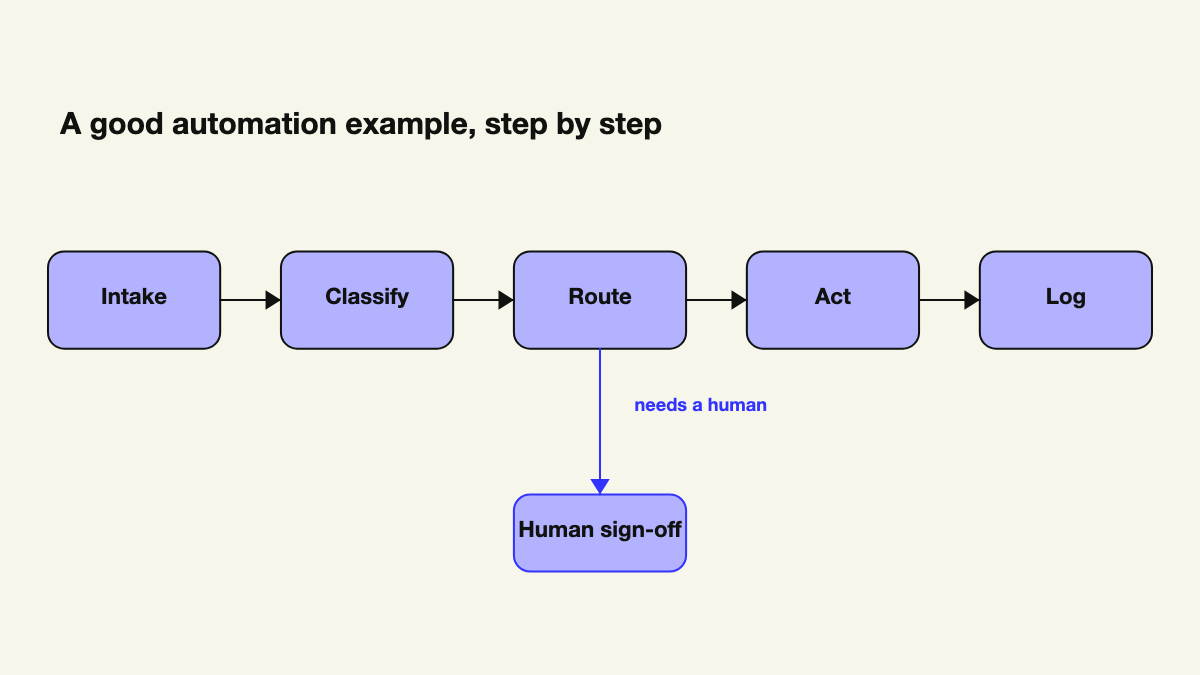
Every example above shares three traits, and a system missing any one is a manual process with a chatbot bolted on, not an automation example. First, it names the specific decision being made instead of a vague capability. Second, it has a measurable before-and-after: hours saved, tickets closed, revenue recovered, not a projected gain nobody checked later. Third, it has a stopping point where a human still signs off, whether that is BioRender’s routing decision landing with a person or the KYC escalation we built that pulls in a compliance check above a set risk threshold.
Here is where I will take a side instead of balancing it: most businesses evaluating AI in business examples should copy the narrow, single-decision pattern from Otter or Viva before they copy the 51-step BioRender build, even though the bigger build photographs better in a case study. A narrow win ships in days and proves the pattern works on your own data before you ask for budget on the harder version. Teams that start with an ambitious multi-agent build usually spend the first month debugging orchestration instead of shipping anything a customer notices. Rush Home did not start with an agent running the whole brokerage. It started with lead scoring, then grew.
The cost of that narrow-first approach is real: you give up the flashier headline number for a while, a fair trade for something running by Friday instead of a roadmap slide still open in December. We have watched the same tradeoff with AI email automation, where clients who started with one recurring reply template got a working system in a week, and the ones who insisted on a fully autonomous inbox from day one spent a month arguing about edge cases first.
Automation, real automation, is not autopilot. AI is nowhere near a set-and-forget system, and the strongest examples here all still route the expensive decision to a person. What changed is which decisions no longer need one.