

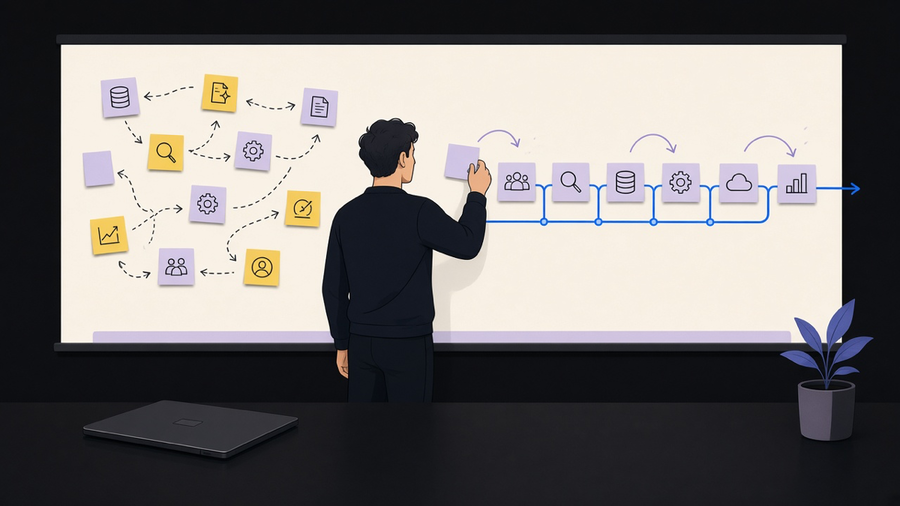
Workflow automation services are the paid work of mapping a broken process, building the integration or bot that fixes it, and staying on the hook when it breaks, as opposed to workflow automation software, which is a license you configure yourself. Search results mix both freely. A vendor selling a platform and a consultant selling delivery time show up on the same page, using the same words, and most buyers do not notice the difference until they have signed a contract for the wrong one.
Workflow Automation Services vs. Workflow Automation Software
The confusion is not an accident. Automation Anywhere’s own workflow automation page defines the term as using RPA and business process automation to “move the right information between IT system components,” which is a fair definition of the technology and says nothing about who configures it, tests it, or fixes it when an API changes. That gap is exactly where services live. A platform gives you the pipes. A services engagement is someone laying them correctly, in your specific building, with your specific water pressure.
Cflow’s roundup of workflow automation companies makes the same mixing mistake at scale, listing platform vendors like Zapier and Cflow itself with nothing about who implements them for a company without an internal automation team. That is most companies. A tool sitting half-configured in a dashboard delivers exactly the automation a spreadsheet delivers, which is none. The services question is not “which platform,” it is “who owns this after the kickoff call ends.”
We treat that ownership question as the actual deliverable. Our average time to a first proof of concept runs about seven days, and we land on-budget on 94% of projects, numbers that only mean anything because someone is scoping the process before touching a tool. If the market is worth anything close to what analysts claim (Markets and Markets pegged the global process automation market at $12.61 billion by the end of 2023, growing at a 13.3% compound rate), a healthy share of that spend is going toward licenses nobody finishes configuring.
What Workflow Automation Companies Actually Sell
“Workflow automation company” gets applied to three different businesses that solve three different problems, and treating them as interchangeable is how a buyer ends up with the wrong one. The first is a product vendor: Automation Anywhere, UiPath, Zapier, Cflow. You buy a seat license and build the automation yourself, or your internal team does. The second is a staff-augmentation marketplace like Toptal, which rents you a freelance developer who happens to know automation tools, priced by the hour with no shared accountability for whether the workflow survives past the contract’s end date. The third is a services agency or consultancy that owns the outcome: discovery, build, and support, usually for a fixed scope rather than a headcount.
None of these is wrong. They solve different jobs. A company with an internal engineering team that just needs more hands might want option two. A company with no automation expertise and a process actively costing money every week it stays manual needs option three, because the first two both assume someone in-house already knows what “correctly configured” looks like. The mistake is picking based on search rank, not delivery model fit.
Most customers, in our experience, only need 10 to 20% of what a full platform license offers, and pay for the rest anyway because nobody scoped the smaller version first. That is not an argument against platforms. It is an argument for figuring out which slice you need before a sales rep sells you the whole thing.
What a Workflow Automation Consultant Delivers, Day to Day
A workflow automation consultant is not a person who installs software faster than you would. The actual work is process discovery: sitting with the team that runs the broken handoff, watching how the exceptions get handled today, and mapping the version of the process that is not written down anywhere because it lives in one person’s head. Integration and testing come after that, and change management, getting the team that has run the process manually for three years to trust the automated version, comes after the integration works and usually takes longer than the build itself.
That part rarely shows up on a vendor’s services page, because it is not a feature anyone can screenshot. We built a customized trigger-and-response system for an HR startup that handled every inbound and outbound activity, including handoffs to third parties, and the harder part of that engagement was not the API work. It was making sure the team trusted the system to route things correctly without checking every case by hand for the first few weeks. A consultant who ships the integration and skips that part has shipped half a job, no matter how clean the code is.
Toptal’s model, freelance talent matched to a project, can work fine for the build itself if the client already owns process discovery and change management internally. It is a weaker fit when the client needs both, which is the more common case. The gap between “we automated it” and “the team actually uses it six months later” is where most workflow automation projects quietly fail, and it is rarely a technical gap.
When Custom Workflow Automation Beats an Off-the-Shelf Platform
Custom workflow automation gets sold on uniqueness, and off-the-shelf gets sold on speed, but neither pitch answers the question that actually decides it: how many exceptions does this process throw, and how many systems does it touch. A workflow with one clean path and two systems is a good fit for a no-code connector like Zapier or Make, configured in an afternoon. A workflow with a dozen exception branches, three legacy systems with no clean API, and a compliance requirement that changes the routing depending on transaction size needs someone building custom logic, because the platform’s rule engine will not bend that far without turning into an unmaintainable pile of conditional steps.
We built exactly that kind of system for a client processing payments at a volume where fraud exposure mattered: a custom flow that escalated select transactions through a KYC process, tuned so it felt unremarkable to end users while protecting the business on transactions that warranted scrutiny. No off-the-shelf platform ships that logic out of the box, because the routing rules were specific to that business’s own risk tolerance.
Working with clients to customize tooling and process takes more hours up front than pointing them at a platform and walking away. It also gets better results, and it is cheaper over a longer horizon, because nobody is paying for a license configured to 20% of its capability three years later. That is the trade custom automation makes: more time to build, less time spent working around a tool that never fit in the first place.
How to Evaluate a Workflow Automation Vendor or Partner
Every workflow automation company’s evaluation checklist happens to favor its own delivery model, which is worth being suspicious of. A platform vendor’s checklist emphasizes feature count. A staffing marketplace’s checklist emphasizes speed to hire. Neither is wrong to want, but neither determines whether the automation still works in a year.
A better checklist scores five things: who owns process discovery before any build starts, who owns the integration once it touches more than one system, what the security and compliance posture looks like for that specific process (payment routing and HR data carry different requirements), what the support agreement covers after the build ships, and what happens to the workflow and its data if you switch vendors later. That last one gets skipped constantly, and it decides whether “custom workflow automation” means something you own or something you rent indefinitely from whoever built it.
Agencies can be excellent, but only about a third of the ones pitching this work are genuinely strong at it, reliably around when something breaks, and staffed by people who understand your business well enough to make judgment calls without a six-week onboarding. That is fewer than the search results for “workflow automation companies” suggest, and it is worth checking references for exactly those three things before signing anything, rather than trusting a case study page written by the same company grading its own homework.
Read what workflow automation is if the services-versus-software split above raised more questions than it answered, or look at concrete workflow automation examples to see what a correctly scoped build actually looks like before you scope your own. If you already know you want the platform route instead of a services engagement, the comparison in workflow automation platform covers that fork directly. Smaller teams evaluating this for the first time should start with workflow automation for small business, where the stakes of picking the wrong delivery model are highest relative to budget. And if what you actually need is someone to own the build end to end, that is the custom workflow automation work we do directly.