

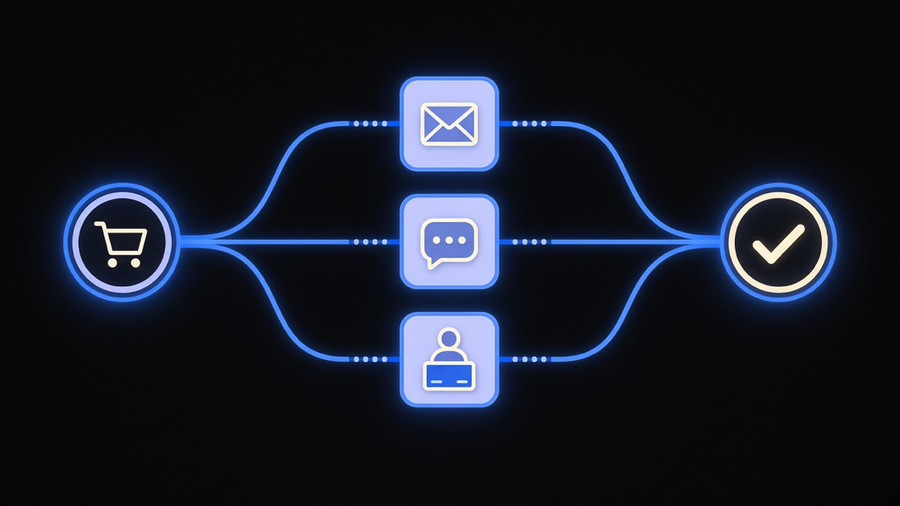
Marketing automation is software that watches for a customer action, an abandoned cart, a form fill, a pricing page visit, and fires a pre-built response without a person clicking send. That is the whole idea. The automation part isn’t the campaign, it’s the trigger-to-response loop running on its own once someone has set it up. Everything else people mean when they say “automation in marketing,” lead scoring, drip sequences, ad bidding, chatbot replies, is a variation on that same loop applied to a different channel.
The confusion around the term usually comes from people conflating the software category with the strategy. A marketing automation platform is the tool. Marketing automation is what you do with it. You can own the most expensive platform on the market and still be manually exporting spreadsheets every Friday, which is not automation, it’s just an expensive place to store contacts.
How Marketing Automation Actually Works
The mechanics are simpler than the marketing around them suggests: trigger, condition, action, and a way to measure what happened. A prospect starts a checkout and quits. That’s the trigger. The platform checks a condition, maybe cart value above a threshold, maybe first-time buyer. Then it fires the action: a reminder email in two hours, a discount code in twenty-four. IBM’s rundown of the category lists the same handful of jobs showing up again and again across vendors: triggered actions from behavior, A/B testing that reroutes traffic to the better-performing version automatically, and lead scoring that ranks who gets a sales call first (IBM, ibm.com/think/topics/marketing-automation).
None of that requires a person to be watching in real time, which is the entire point. A human designed the workflow once. After that, the system runs it a thousand times without getting tired or forgetting a step, the one advantage no amount of hiring solves.
Where this breaks down is data. A workflow that fires off “welcome back” emails to someone who never left, because two systems don’t agree on what “active” means, is a common failure mode. Automation only works as well as the data feeding it, and most platforms will happily run a broken trigger forever without complaining. That’s on setup, not on the software.
What a Marketing Automation Platform Actually Is
A marketing automation platform is the system of record for the triggers, segments, and messages, plus the interface a marketer uses to build and monitor them without writing code. That’s it. It’s not a growth strategy and it’s not a replacement for a media plan. It’s the engine room.
Most platforms bundle four things: contact segmentation, workflow building, channel delivery (email, SMS, sometimes ads), and reporting. Some, like the marketing automation platform category leaders, package all four into one product. Others are point tools that do one piece well and integrate with the rest of your stack.
Here’s the opinion part: most teams only need ten to twenty percent of what a full platform does, and they end up paying for the other eighty percent anyway because the contract is annual and the sales rep bundled it that way. If your actual use case is “send a sequence after signup and score leads for sales,” you don’t need the platform that also runs programmatic ad bidding. Buy the slice you use. The advantages of marketing automation show up fastest when the tool matches the job, not when it matches the demo.
Types of Marketing Automation
The taxonomy splits by channel and job more than by vendor, and knowing which type you actually need keeps you out of the eighty-percent trap above.
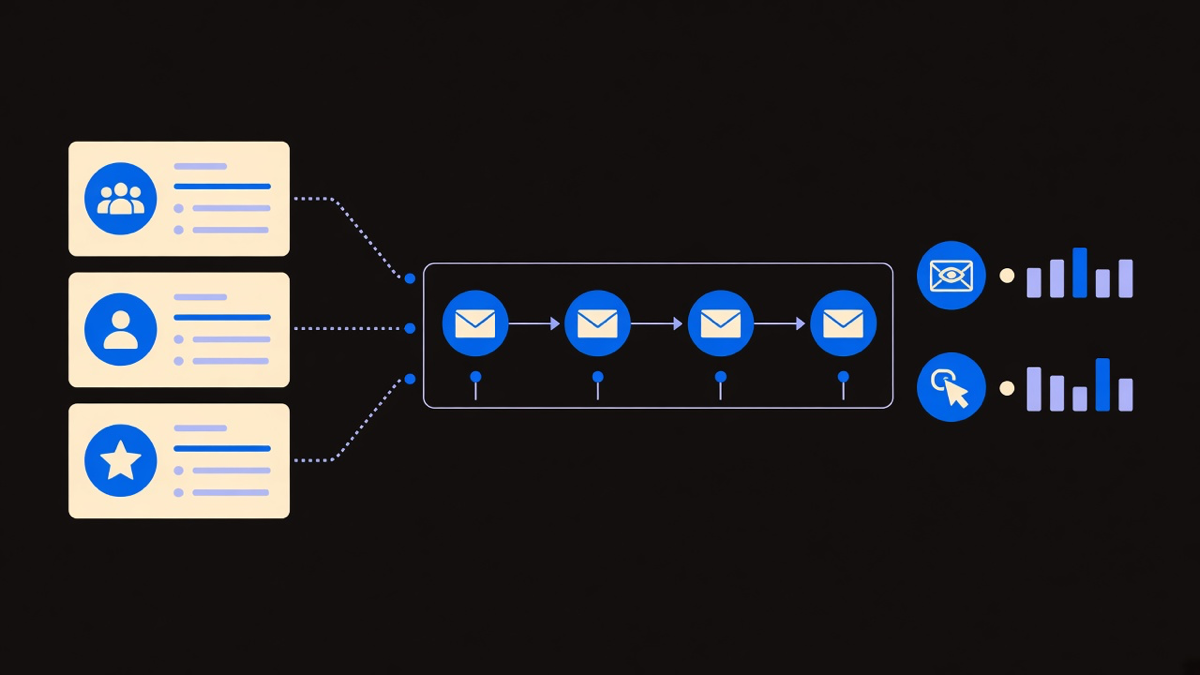
Email and lifecycle marketing is the oldest and still the workhorse: welcome sequences, cart abandonment, re-engagement after sixty days of silence. CRM-adjacent automation handles lead scoring and routing, deciding which lead a rep calls first based on behavior instead of gut feel. Programmatic advertising automates the buy and sell side of ad auctions in real time, which nobody could do by hand at the volume modern ad exchanges run (IBM, ibm.com/think/topics/marketing-automation). Social scheduling and listening tools queue posts and route brand mentions to a human when something needs a real reply. Chatbots handle the first layer of customer questions before escalating.
Forrester projected marketing technology spend would hit $148 billion by the end of 2024, and most of that money is buying some slice of this list, not one universal tool (IBM, ibm.com/think/topics/marketing-automation). The marketing automation workflows that actually get used inside a company are usually two or three of these types stitched together, not all five running at once.
Where Automation Stops and a Person Has to Take Over
Generative AI is the newest layer on top of all this, and it is genuinely useful for the parts that were already mechanical: drafting subject line variants, summarizing a customer’s history before a call, filling in a missing data field. McKinsey estimates generative AI could lift marketing productivity by up to fifteen percent of total marketing spend, somewhere around $463 billion a year at current spend levels (McKinsey, cited via IBM, ibm.com/think/topics/marketing-automation). That is a real number attached to a real category of work, not a vendor slide.
What it does not do is replace judgment about which lead is actually worth a phone call, or notice that a “high engagement” score is really just one person opening the same email eleven times because their inbox preview broke. AI and automation platforms are strong at grunt work and pattern matching. They are not close to running on autopilot without someone who understands the business checking the output, and any platform that claims otherwise is selling the demo, not the tool.
This is also where marketing automation and sales tooling get mixed up, and it’s worth being precise about the boundary. Marketing automation nurtures a lead until it’s ready. A sales engagement platform picks up from there, sequencing the actual outreach a rep sends once a human is in the loop. They share triggers and data, but one runs before a person is involved and the other runs because a person is. Confusing the two is how companies end up buying the same capability twice under different vendor names.
If you’re evaluating vendors next, start from the workflow you actually need to run, not the feature list. Every best marketing automation companies list reads the same on the surface: email, scoring, reporting, integrations. The difference that matters is whether the platform’s defaults match how your team actually works, or whether you’re going to spend the first ninety days rebuilding their template into something usable. That gap is where most of the eighty percent of unused features comes from in the first place.
Marketing automation earns its name when the trigger fires and nobody has to remember to check it. Everything short of that, no matter how many dashboards it has, is just software waiting for a person to run it manually.