


Marketing automation for small business means one thing in practice: a lead who fills out your contact form gets a response whether you were watching the inbox or not. That is the whole pitch, stripped of the enterprise language most vendors bury it under. A five-person company does not need a demand generation platform. It needs the form submission at 9pm on a Sunday to trigger the same email, the same tag, and the same handoff that would happen if someone happened to be at a desk. Everything else, the scoring models, the multi-channel attribution dashboards, the AI-written subject line tests, is downstream of that one job and most small businesses will never touch it.
What Marketing Automation Actually Does for a Small Team
A small team does not lack ideas. It lacks a second person to remember things. Before automation, most “marketing operations” is a founder or a single marketer keeping a mental list: reply to the demo request, follow up with the quote from two weeks ago, remove the customer who already bought from the promo list. That list lives in someone’s head, and heads get full during a launch week or a vacation.
Automation replaces the remembering, not the thinking. A trigger fires when someone fills out a form, opens three emails in a week, or abandons a cart, and a predictable response goes out without anyone checking a dashboard first. The strategy behind what that response says still has to come from a person who understands the customer. Buy the wrong platform and you get a consistent, fast version of a bad email. This is where the real advantages of marketing automation show up: not creativity, but follow-through that does not depend on who is awake.
The tension worth naming here: most small businesses do not have a marketing problem they can solve by automating faster. They have a marketing problem, full stop, and automation executes whatever they already do at higher speed. If the nurture sequence is generic and the offer is weak, automating it means more people see the weak offer, faster. Fix the message first. Automate second.
Choosing Tools When You Have No Time to Manage Them
The honest criteria for a small team is not “which platform has the most features.” It is which platform someone with no spare hours can keep running six months from now. Most software gets bought during a burst of enthusiasm and then quietly ignored once the person who set it up gets busy again, which is how a $400-a-month tool ends up sending three emails and nothing else.
Three things matter more than the feature list. First, does it connect natively to the tools you already use for email, CRM, and your storefront, or does every workflow need a Zapier bridge that breaks silently. Second, can one non-technical person build and edit a sequence without a consultant on retainer. Third, does the pricing scale with your list size in a way you can predict, instead of jumping tiers the moment you cross an arbitrary contact count. Most customers only end up using ten to twenty percent of what a given platform can do, while paying for the other eighty percent because the sales rep upsold the annual plan. A smaller, sharper toolset beats a platform you rent and barely open.

This is also where it is worth being honest about what a platform search is for. Reading a rundown of the best marketing automation companies is useful for narrowing the list, but the right pick still depends on which two or three workflows you are trying to fix this quarter, not which vendor wins the most review sites.
The Software Categories That Actually Fit a Small Team
Most small business marketing software falls into three buckets, and the mistake is picking from the wrong one for your stage.
Email and CRM combo tools are the right starting point for almost everyone. They handle welcome sequences, abandoned cart reminders, and basic lead tagging without asking you to learn a separate automation builder. If your whole operation is one inbox and one spreadsheet of contacts, start here and nowhere else.
All-in-one marketing suites make sense once you are running paid ads, email, and a landing page builder and want one login instead of four. The tradeoff is real: you get breadth at the cost of depth, and the automation builder inside an all-in-one suite is usually weaker than a dedicated tool built for that one job. Fine for a five-person team. A worse deal for a team that has outgrown the basics and needs the workflow engine to be the strongest part of the stack, not an afterthought bolted onto a page builder.
Workflow connectors sit on top of whatever you already have and stitch it together, which is the right layer once your form tool, CRM, and inventory system need to talk to each other and none of them were built by the same company. This is also usually where a business first needs to think in terms of marketing automation workflows instead of single triggers, because now one event has to update three systems, not one.
If your storefront runs on Shopify, it is worth knowing where the platform’s own automation stops. Shopify Flow handles inventory and order events well, but it was never built to run a full nurture sequence or score a lead, so the moment your marketing needs cross that line you are choosing between duct-taping apps onto Shopify or bringing in a real marketing platform next to it. That line between native Shopify automation and a dedicated marketing platform is exactly where a lot of small ecommerce teams overspend on the wrong side of the decision.
Building the Sequence in the Right Order
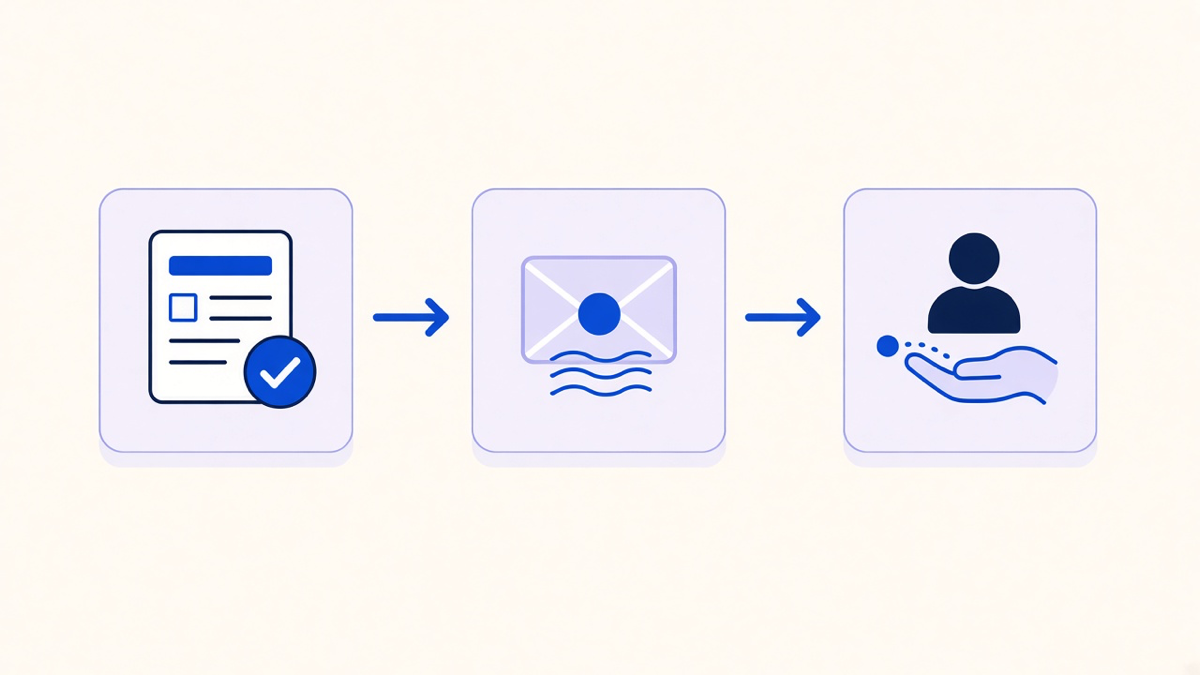
The order that works, in almost every small business we have seen this pattern in: capture, nurture, handoff. Skip a step or build them out of order and the automation looks busy without doing anything useful.
Capture comes first because nothing downstream matters if leads are not landing somewhere trackable. That means one clean form, one clear destination for the contact record, and one immediate acknowledgment, even if the acknowledgment is only “we got this, here is what happens next.”
Nurture is the sequence that runs while a lead is deciding, and it is the part most businesses over-engineer before they have earned the complexity. Three to five emails spaced over two weeks, each answering one real objection, beats a twelve-step drip that nobody on the team could summarize from memory. If you cannot explain what each email in the sequence is for in one sentence, cut it.
Handoff is the step small businesses skip most often, and it is the one that loses revenue. A lead that hits a buying signal, pricing page visited twice, demo requested, cart sitting for an hour, needs to reach a human fast, and automation’s job here is routing, not replacing the conversation. We built something close to this for an HR startup that needed both inbound and outbound activity running through one system of triggers and handoffs into third-party tools their sales team already used. The improvement was never that the automation was clever. It was that a lead who showed up at 2am got the same response as one who showed up during a Tuesday team meeting, and nobody had to be at a desk for either.
What This Costs You If You Get It Wrong
The failure mode is not usually “automation didn’t work.” It is a tool running quietly in the background sending the wrong message to the wrong segment for months, because nobody reviewed it after the person who built it moved on. That is worse than doing nothing, since it looks like marketing is happening while it is actively working against the brand.
Marketing is hard enough when a human is running it deliberately. Handing a weak strategy to an automation platform means the mistake gets repeated on schedule instead of once. Pick the smallest tool that covers capture, nurture, and handoff for your actual list size, staff one person to own it, and revisit the sequences quarterly. That is the whole system. Everything past that is a feature you are paying for and not using.