

A simple app runs $15,000 to $60,000, a mid-complexity business app runs $50,000 to $200,000, and anything with compliance, real-time features, or enterprise integrations runs past $300,000, according to the agency pricing pages dominating search results for this question. None of those numbers come from a public survey with disclosed methodology. They come from vendors quoting their own project history, and two agencies pricing the same feature list can land $100,000 apart depending on where their engineers sit and what they count as “maintenance.” That gap is the real story.
What the quote covers, and what it quietly doesn’t
Before comparing dollar figures, pin down what’s inside the box. Wezom’s published breakdown allocates a typical build as 5 to 10 percent discovery and planning, 10 to 20 percent prototyping and design, 40 to 60 percent development, 10 to 20 percent QA, and 5 to 10 percent deployment, with early maintenance folded into that quote. Netguru draws the line differently: design, development, QA, and initial store deployment are in the number, ongoing maintenance is not. Ask which model you’re getting before comparing two quotes, because one bundling post-launch support looks more expensive than one that doesn’t, for identical engineering.
Testing eats more of that number than most founders expect. Netguru cites Capgemini’s World Quality Report 2024 putting QA at 20 to 25 percent of total development hours, a figure that tracks with what shows up in the mobile app development process once device fragmentation and store review cycles enter the picture. A good share of that QA hour count is android app development specific: testing across a dozen screen sizes and OS versions costs more than testing a single iPhone lineup. The fixed costs are what everyone agrees on: Apple’s Developer Program membership is $99 a year, Google Play registration a one-time $25 fee. AppZoro’s breakdown adds what quotes tend to omit: third-party APIs like Stripe, Twilio, or mapping services running $500 to $10,000 a month at scale, plus push and analytics tooling adding $200 to $2,000 more. Store fees are a rounding error next to engineering. The recurring API bill is not.
Published ranges by complexity, and why they don’t agree
Four agencies publishing 2026 pricing pages give four different floors for a “simple” app. Wezom puts a basic MVP at $15,000 to $50,000. AppZoro’s simple tier runs $25,000 to $60,000. Onix publishes $1,000 to $10,000, a floor nobody else comes close to. Netguru’s own page even contradicts itself across two tables, listing simple apps at both $15,000 to $50,000 and $15,000 to $25,000. Treat every one of these as a vendor estimate built on that vendor’s own project mix, not a market average. No independent dataset sits behind any of them.
The number worth trusting most is Netguru’s claim of a $76,000 median for a cross platform mobile app development MVP (authentication, an API connection, 8 to 12 screens) drawn from a stated base of over 200 projects, since it names a sample size and a feature set instead of a vague adjective like “simple.” Add HIPAA compliance or a real-time feature and the median jumps to $118,000. Enterprise builds with AI features or heavy compliance scope run $350,000 to over $1,000,000 across every vendor publishing a top tier. A flat quote for “an app” with no questions about scope is a guess wearing a decimal point.
What actually moves the number: features, rate, and geography
Run the math as Onix frames it: cost equals features times development time times hourly rate. A social login feature runs 8 to 16 hours at a typical $40 hourly rate, so $320 to $640. A chat feature runs 40 to 120 hours at that rate, so $1,600 to $4,800, while Netguru’s higher-rate react native app development estimate puts the same chat feature at $12,000 to $35,000. The feature list barely moved. The hourly rate did all the work, the biggest lever most comparison articles bury under feature tables.
Geography sets that rate more than anything else. AppZoro estimates a 1,500-hour build at $225,000 to $330,000 with a US team billing $150 to $220 an hour, versus $37,000 to $90,000 with an Indian team billing $25 to $60 an hour, a gap that looks like free money until AppZoro’s next line: communication overhead and rework can erase 30 to 50 percent of that apparent offshore savings. I’ve watched that play out. A team costing half as much per hour but needing three rounds of clarification on every ticket is not cheaper, it’s deferred cost with a longer fuse, and the agencies worth hiring at any rate are the minority reachable in your working hours and honest about scope before billing starts. Compliance adds its own line item too: HIPAA, PCI, SOC 2, or GDPR work can add $20,000 to $100,000.
Feature estimates only mean something once rate and scope are named, the point of planning how to make a mobile app around a real spec instead of a verbal pitch. Ask any vendor for hours by role, not a lump sum.
Native vs cross platform: the cost gap is real but smaller than the pitch decks claim
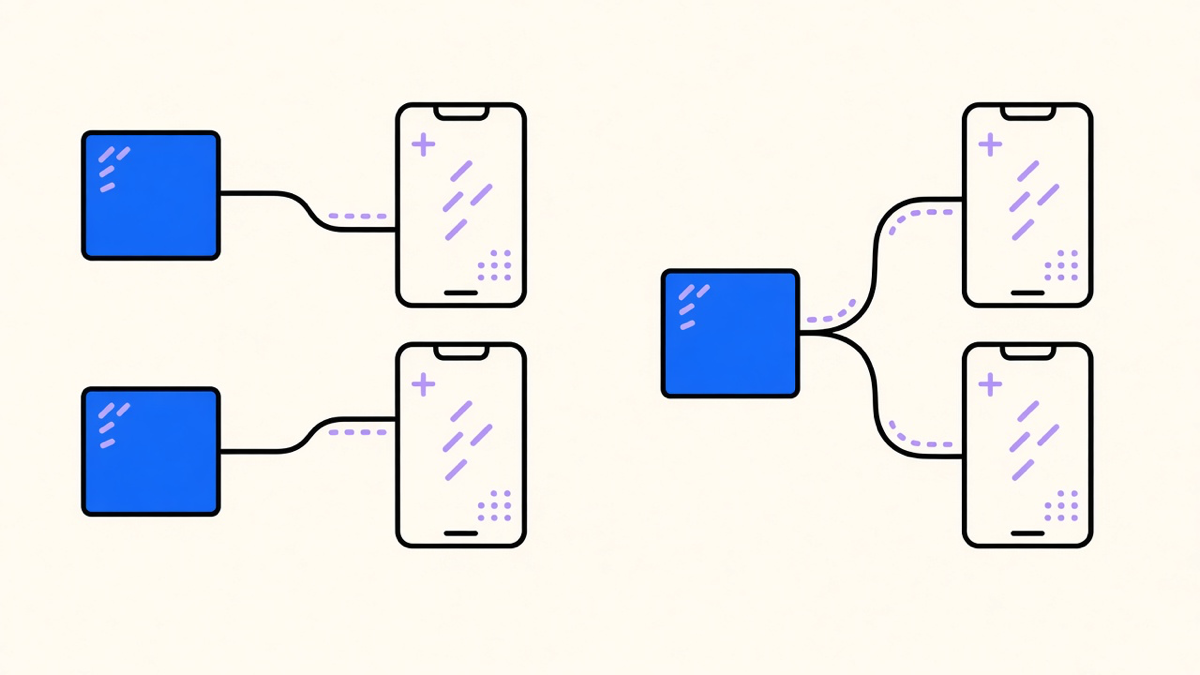
This is where vendor marketing overstates its case. AppZoro claims building both platforms natively runs about 1.7 times the cost of a cross platform mobile app development build from day one, roughly a 40 percent cut by going shared codebase. Netguru lands closer to 30 to 45 percent in combined development time, putting React Native at 60 to 70 percent of dual-native cost, and separately describes shared-code builds landing at 1.3 to 1.5 times a single native build, not the full 2x two native builds would cost. Different math, same conclusion: cross platform saves real money, a third to half of what two native teams cost, not the 90 percent some sales pages imply.
The native vs hybrid distinction gets muddled in most of these pricing pages, since several lump React Native in with Cordova-style hybrid apps running inside a WebView. They are not the same build or the same maintenance bill. Hybrid apps price lower up front in both Onix’s and Netguru’s tables, but Netguru flags higher year-two maintenance debt on that stack, matching what you’d expect from a WebView bridge accumulating workarounds faster than a compiled native view. My take: default to a cross platform codebase like React Native unless the app leans on camera processing, AR, or background audio hard enough to need direct native access, and don’t let a hybrid quote’s lower sticker price hide the maintenance bill waiting in year two. The savings are real, just smaller and slower than the pitch implies.
Timeline, maintenance, and the bill that keeps arriving after launch
Timelines cluster predictably by tier: a simple MVP lands in 8 weeks to 4 months, a mid-complexity business app takes 4 to 7 months, an advanced or enterprise build runs 7 months to 2 years. Those ranges hold only when the build runs on fixed-length sprints with a backlog and real device feedback between cycles, the agile mobile app development pattern most vendors assume but rarely name. A waterfall plan promising one clean build-then-launch pass tends to blow past those timelines, because it has no checkpoint for the feedback a sprint cadence forces early.
None of those timelines include what happens after the store listing goes live, and that’s the real budgeting mistake. Every vendor publishing a maintenance figure lands in the same neighborhood: Wezom says 15 to 30 percent of original development cost per year, Netguru says 15 to 20 percent citing Dev.to and its own portfolio, and Onix cites a Clutch survey figure of $10,000 to $14,000 flat, a number that stops scaling once a build passes six figures. Netguru’s own example: a $150,000 build runs $22,500 to $30,000 a year in maintenance before a single new feature gets added, split mostly between OS updates, bug fixes, and security work.
Run that forward two years and Netguru’s own framing gets blunt: post-launch obligations routinely consume 40 to 60 percent of the original build budget within two years. That’s compounding, not a scare number. Each OS release forces compatibility work, each new regulation touches compliance again, and each abandoned third-party SDK forces an unplanned replacement. Budget the maintenance percentage from month one, not as a surprise the year after launch.
So when someone asks how much mobile app development costs, the honest answer has three parts: a complexity tier that sets the floor, an hourly rate set by who’s writing the code and where they sit, and an annual maintenance bill worth 15 to 30 percent of the build that starts the day you launch, not when it feels optional. Anyone quoting a single number without asking about all three hasn’t scoped the project, they’ve guessed at it. That scope, done properly before a number gets attached, is the actual service worth paying for in mobile app development.