


Business automation services are paid, hands-on work: a team assesses your actual processes, then designs and builds the integrations, bots, or AI steps that remove the manual handoffs, rather than selling you a platform license and leaving you to configure it. That distinction sounds small until you’re the one holding an unused Zapier account six months after the sales call. The services version costs more upfront and ends with something that runs. The software-only version ends with a login nobody uses.
What “Business Automation Services” Actually Means
Every vendor in this space blurs the line between selling a tool and doing the work with the tool, because blurring it is good for margins. ScienceSoft, a services firm founded in 1989, is upfront about the difference on its own site: business automation there means an assessment, an ROI calculation, and hands-on implementation, not a shrink-wrapped product. Hyland, which does sell BPA software, still frames the category the same way when it lists onboarding, purchase orders, and incident reporting as the recurring examples, each one a process that spans multiple departments and can’t be fixed by one person clicking around in a dashboard.
That’s the real test for whether you need services or a tool. A process that lives inside one app, like auto-tagging support tickets, is something a subscription can handle. A process that crosses systems, like a purchase order that starts in email, gets approved in Slack, and lands in an ERP three days later, needs someone to actually build the connective work. Automation Anywhere’s own materials point to the same gap when they list “ease of use for non-technical staff” and “integration and scale” as the two things buyers should evaluate before picking a platform. Both of those are people problems dressed up as software features.
What a Business Automation Company Actually Delivers
A business automation company worth hiring does three things in order: maps the current process with the people who run it, scopes what’s actually broken, then builds. Skip step one and you get automation built around a guess. We’ve had clients arrive after working with agencies that skipped straight to selling a package, the kind that oversells during the pitch, underdelivers on the build, and locks the client into a multi-year contract regardless of results. The tell is usually the same: the proposal reads identically for every industry, because it is.
The honest version of this work is slower and smaller in scope than the pitch deck version. We cap new engagements deliberately, running 2 to 3 new clients a month with a waiting queue rather than stretching a team thin across ten half-built projects at once. That’s a business decision, not a humblebrag. A team spread across too many clients ships automation nobody stress-tests, and the client finds out during month four when the exception case the bot never handles finally shows up.
If you’re weighing a business automation company against doing it in-house, the honest answer depends on whether anyone internally owns the process today. If nobody does, hiring the outside team to both diagnose and build is worth the premium. If someone already owns it and just needs execution hours, you can hire more narrowly and skip the discovery phase.
Process Automation Solutions: RPA, Workflow Tools, and Where AI Fits
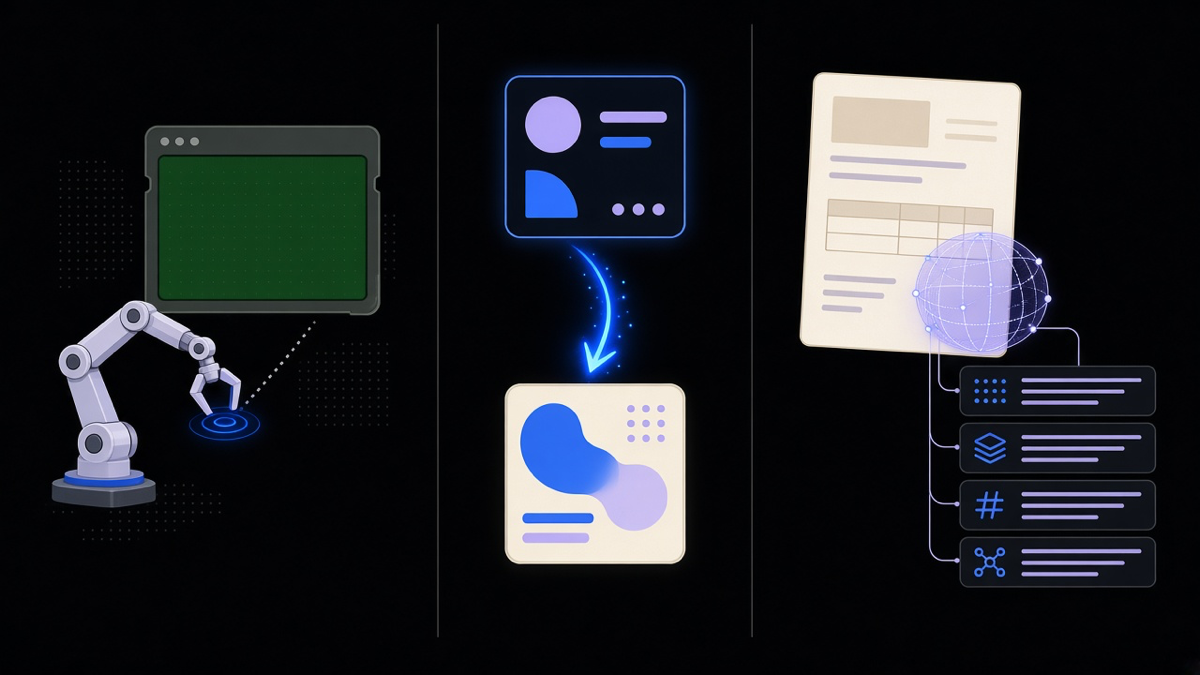
“Process automation solutions” gets used to describe three different technical approaches, and knowing which one applies changes the entire scope of work. Robotic process automation is a bot mimicking clicks across an existing UI, useful when the underlying system has no API and nobody’s rebuilding it soon. Workflow and integration platforms connect systems through their APIs directly, which is faster to build and easier to maintain than an RPA bot but requires the systems to actually expose an API in the first place. AI document processing sits on top of either one, reading unstructured input (a scanned invoice, a free-text support ticket) and turning it into structured data the rest of the pipeline can use.
Automation Anywhere’s own case study numbers show what happens when the scoping is right: Petrobras reports $120 million in savings identified within three weeks of an automation engagement, alongside a 40% jump in process efficiency. That’s a big company with big existing waste to find, so treat it as a ceiling, not a typical result, but the pattern underneath it holds at any size: the savings show up fast when the target process was already the bottleneck, and they don’t show up at all when the automation gets pointed at a process that was fine to begin with.
This is also where workflow automation services and full business process automation stop being the same purchase. Workflow automation usually means one sequence inside a tool. A business process automation engagement means that sequence connected end to end across every system it actually touches, which is a bigger scope and a bigger price, for a reason.
The Numbers That Justify the Spend, and the Ones That Don’t
ScienceSoft cites a figure worth sitting with: businesses can lose 20 to 30% of revenue annually to inefficient processes, low productivity, and avoidable cost, and the firm ties automated workflows to a 15% drop in process error rate and a 10% gain in process speed from centralized data. Those numbers are directional, not a guarantee your specific invoice process behaves the same way. What they do confirm is the order of operations that matters: measure the current process’s error rate and cycle time before automating it, or you have no way to know afterward whether the spend worked.
Most customers only ever need 10 to 20% of what a full automation platform offers. The other 80% sits in the license as a sunk cost, a feature they were sold on but never touch. I’d rather scope a client into the smaller, correctly sized build every time, even though it’s the lower-margin sale for us. It holds up in month twelve, which is the only month that actually matters to the person who approved the budget.
Deciding Between Business Process Automation Services and a Platform You Run Yourself
The honest hire-vs-buy call comes down to three questions, and none of them are about price. Does anyone in-house own the process end to end today? Does the volume justify a dedicated build, or is this a once-a-quarter task better left manual? And is the system you’re automating around one you control, or a vendor’s black box that might change its API next quarter without telling you? A “yes” to ownership and volume, and a “no” to the black-box risk, points toward buying a platform and running it in-house. Any other combination is the case for hiring services instead.
Small teams tend to land on the same answer for a different reason: nobody has the spare hours to own both the process and the platform, so workflow automation for small business usually means a lighter build with a heavier reliance on the vendor doing the diagnosis. Understanding what workflow automation is at the single-task level first makes it easier to tell whether your actual problem is a process crossing five systems or a form that just needs one connector, and that answer decides whether you need a services engagement at all.

The pitch decks make automation sound like a purchase decision. It’s a diagnosis decision first, and the purchase, whether that’s a services contract or a platform license, only pays off once someone has actually named the process that’s broken.