

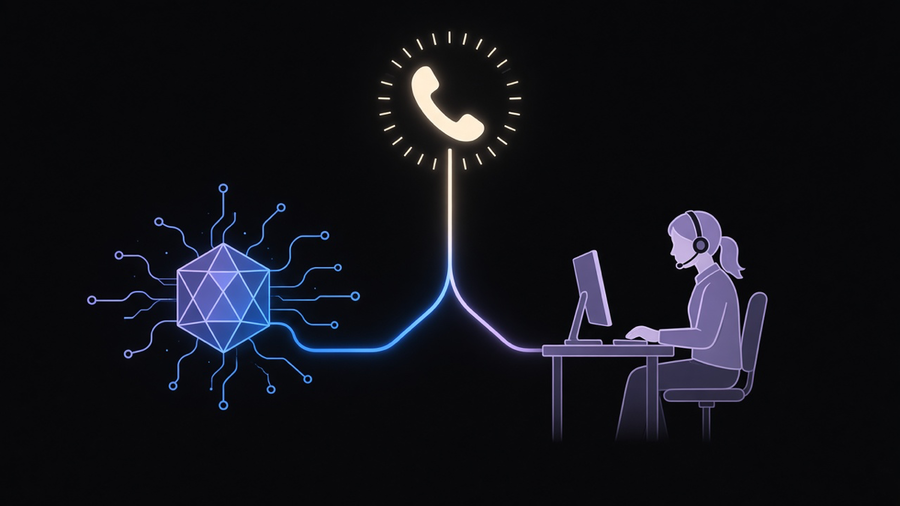
An AI call center is a phone support operation where software, not a person, handles the first pass of every call: answering it, understanding the request, and either resolving it directly or routing it with full context to a human. Zendesk frames it as a call center “powered by artificial intelligence to automate, enhance, or manage the majority of a call center’s operations,” and that word majority is doing real work. Nobody serious is claiming full replacement. Salesforce’s own research puts a number on the trend line: by 2027, 50% of service cases are expected to be resolved by AI, up from 30% in 2025. That is a fast climb, and it explains why “ai call center” has become a search term instead of a niche vendor pitch.
What Is an AI Call Center, Really
Strip away the vendor copy and an AI call center has three working parts: a voice layer that turns speech into text and back, a reasoning layer that decides what the caller needs, and an integration layer that pulls account data, order status, or a knowledge base article into the conversation before it answers. IBM’s definition centers on this same idea, describing contact center AI as software that automates and enhances interactions “with limited or no human agent involvement.” That phrase, limited or no involvement, is the honest range. Some calls close with zero human touch: password resets, order status, appointment confirmations. Others get partial automation, where the AI drafts a response or pulls up the right account screen and a human finishes the call.
The confusion in most searches for this term comes from conflating the call center with the software that runs it. A traditional call center is a group of people answering phones with a script and a CRM open in another tab. An AI call center still has people in it, fewer per call volume, and the software absorbs the repetitive first fifteen seconds of most calls: identity verification, intent capture, and routing. That absorption is the entire pitch, and it is a real one, but it is not the same claim as “the AI replaces the call center.”
Contact Center AI as a Capability Layer, Not a Product Category
Contact center AI is not one tool. It is a set of capabilities that show up across a call center’s stack: intelligent routing that sends a call to the right queue based on what the caller said, agent assist that surfaces a suggested answer while a human is still on the line, real time transcription and summarization so nobody re-types call notes, and analytics that score sentiment and compliance on every call instead of a sampled handful. Zendesk’s own breakdown of AI call center software lists these as separate features because they get bought and deployed separately. A company might add call transcription this quarter and agent assist next quarter, leaving self-service untouched.
This matters because “buy an AI call center” is not a single purchase decision the way “buy a CRM” is. It is closer to a stack of five or six decisions, each with its own vendor options and its own integration cost. Treating it as one line item is how a rollout stalls: someone signs a contract for “the AI call center platform,” discovers it only covers voice transcription, and now has to buy routing and analytics separately anyway. My take, having watched clients do this the hard way and the easy way: scope the specific capability you are short on first, ticket transcription, routing accuracy, or after call summaries, and buy that piece. The full platform sale sounds efficient in the demo and turns into three vendor relationships in practice regardless.
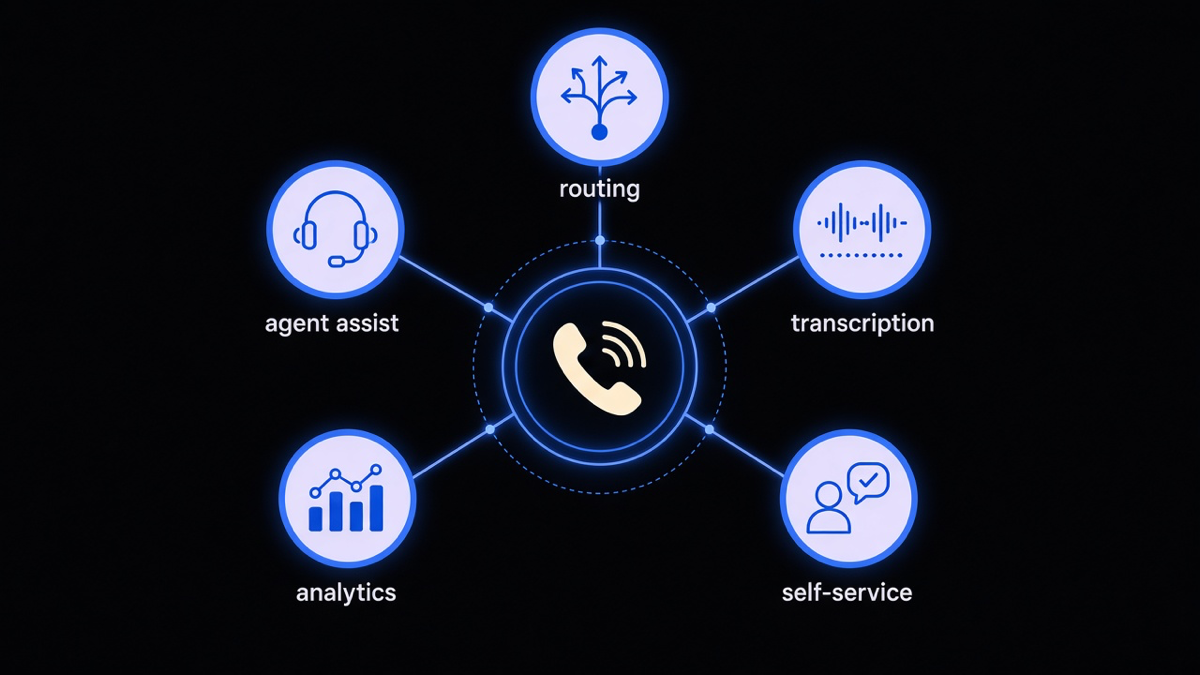
Genesys frames the same capability set from the agent side rather than the platform side, describing AI call center agents handling high volume inquiries, boosting human agent productivity with copilots, and enabling predictive engagement. The framing difference is worth noting. Genesys and Zendesk both describe the same underlying tools, marketed from opposite ends of the phone call, the customer’s end and the agent’s end.
AI Call Center Software vs. an AI Phone System
The cluster term “ai call center software” usually points buyers toward a narrower question than the phrase suggests: do you need a full contact center platform, or do you need an AI phone system that answers, screens, and routes calls without the analytics and QA layers a large call center runs on top. A ten-person team fielding two hundred calls a day does not need real time sentiment scoring across every interaction. It needs calls answered promptly, routed correctly, and logged somewhere useful. That is a phone system problem dressed up in call center vocabulary.
The distinction shows up again in how calls get routed before anyone talks. Plenty of businesses already run an IVR menu, press one for sales, press two for support, and assume that counts as automation. It is automation of button presses, not of understanding. An AI layer on top of that same call replaces the menu tree with a caller saying what they want in plain language, which is a different product even when it sits on the same phone number. Businesses evaluating AI call center software should separate the two questions: does this replace my phone system, or does it sit on top of a virtual phone system for business I already have and add the understanding layer. Most vendor demos blur that line on purpose because the AI layer sells better bundled with the infrastructure than sold as an add-on.
Where the Human Handoff Belongs
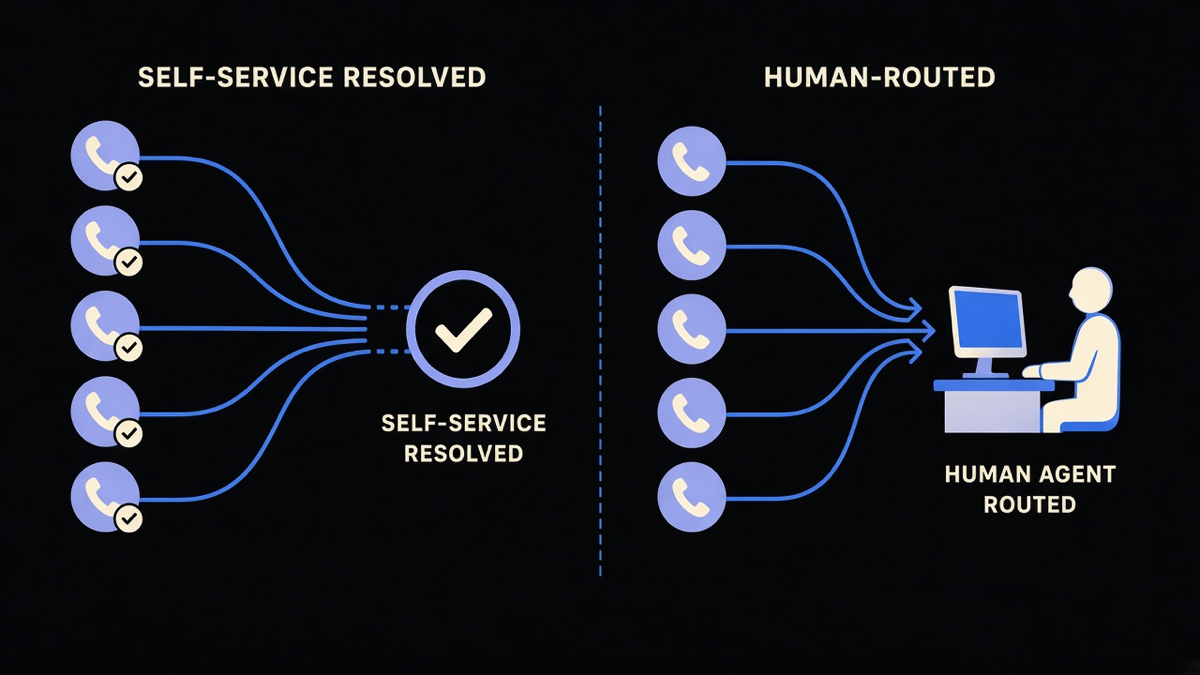
Every vendor guide on this topic includes a section warning that AI should not fully replace human agents, and they are right, but the more useful version of that advice names which calls specifically should stay human rather than repeating the general warning. Billing disputes over a specific dollar amount, anything involving a complaint that could become a refund or a churn risk, and any call where the caller has already said “let me talk to a person” twice, those are the calls that should route to a human immediately, not after two more automated turns trying to resolve it. Genesys notes that even with automation handling high volume inquiries, agent attrition in contact centers still runs high, close to 40% in some industry reporting, which is one more argument for using AI to take repetitive call volume off agents rather than trying to eliminate the headcount outright. Fewer burnout-driving calls per agent is a retention strategy, not only an efficiency one.
This is where I differ from the platform pitch. AI and voice models are genuinely good at pattern-matched requests: status checks, resets, scheduling, FAQ-shaped questions. They are not close to reliable at judgment calls that require weighing a customer’s history, tone, and an exception to policy in the same breath a good human agent makes instinctively. The businesses getting real ROI from an AI call center are the ones that mapped which calls fall into each bucket before deployment, not the ones that bought a platform and hoped the split would sort itself out. That mapping work is unglamorous and it is the real project, not the AI itself.
Evaluating AI Call Center Software Without the Vendor Pitch
Once the human-handoff map exists, evaluating software gets simpler: does it integrate with the CRM you already use, does it support the channels your customers call from, is call recording and transcript storage compliant with the regulations your industry runs under, and can it hand off a call with full context so the human never asks the caller to repeat themselves. That last point sounds small and it is the number one complaint in every review of AI call center deployments that go wrong. A caller who already spent ninety seconds with a bot and then has to restart the story for a human did not save any time; the call center added a step.
We have built this kind of routing and handoff logic directly for clients rolling out AI agents for phone support, not to replace the front desk but to make sure the first touch is faster and the handoff, when it happens, carries everything the human needs. The pattern that works is narrow scope done well: pick the three or four call types that are genuinely repetitive, automate those completely, and route everything else to a human with the transcript already attached. The pattern that fails is buying the platform that claims to handle everything and discovering, six months in, that the analytics dashboard nobody asked for shipped before the routing accuracy anyone needed.