


An AI answering service is software that answers your business phone in a natural voice, handles the call itself when it can (booking, FAQs, taking a detailed message), and routes or texts a human when it can’t. That’s the entire category, whether the marketing page calls it an AI phone answering service, an AI call answering tool, or a virtual receptionist. The differences that matter aren’t in the pitch. They’re in what happens on the calls that don’t fit the script, and in what the word “free” quietly leaves out.
What an AI Answering Service Does That a Voicemail Box Doesn’t
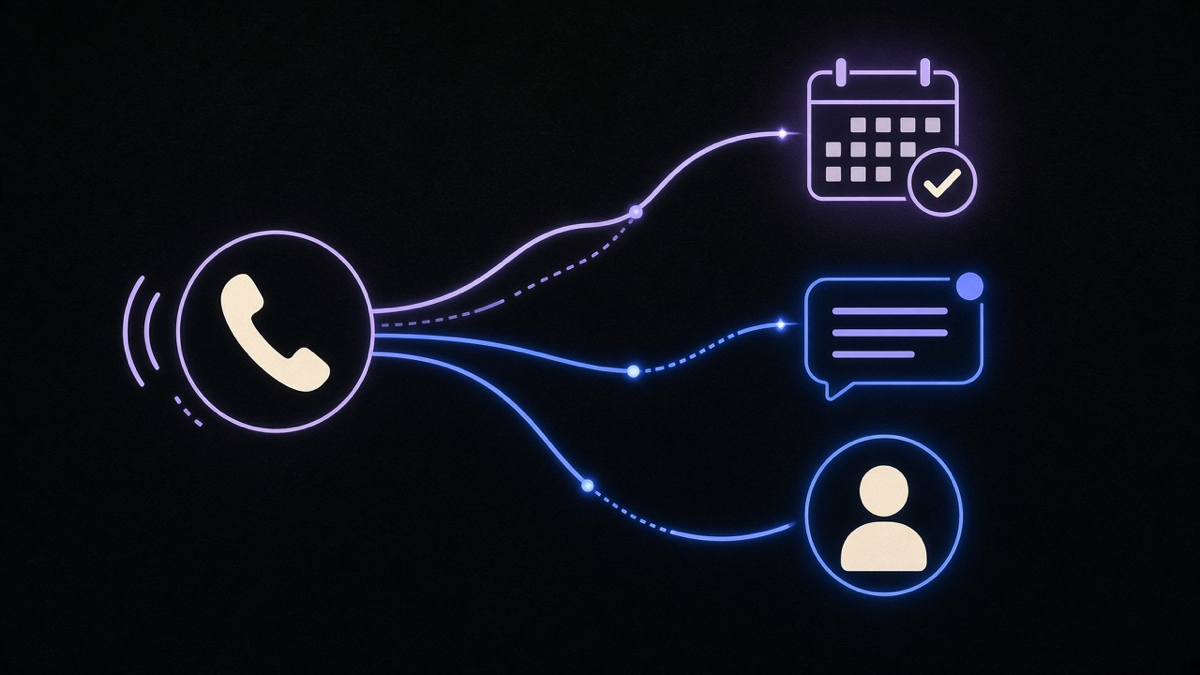
A voicemail greeting gets you a name, a callback number, and a vague reason for calling, if the caller bothers to leave one. An AI answering service holds an actual conversation: it understands “can I move my Thursday appointment to Friday” without a menu, checks your calendar, and either books the change or texts you to confirm. That gap is the whole reason this category exists instead of everyone just running a fancier voicemail greeting.
The stakes are bigger than they look. OnceHub’s 2026 guide to automated call handling cites research putting missed inbound calls at 25 to 60 percent of total volume for small and mid-sized businesses, depending on staffing and after-hours coverage. Separate research it references found that engaging a lead within the first 60 seconds can lift conversion by close to 400 percent. Put those two numbers next to each other and the business case writes itself: half your calls might already be going unanswered, and the ones that get answered fast convert at a completely different rate. An AI phone system that just plain picks up is doing more for your pipeline than most of what marketing spends on the same lead.
We built exactly this for an operator scaling a growing business into 24/7 phone coverage: not to replace the front desk, but to make sure the first touchpoint held up whether it landed at 2pm or 2am, with the calling routed through custom APIs and analytics while keeping the business’s own tone on the line. That’s the part vendors gloss over in their demo videos. The AI answering the phone in your brand’s voice is a build decision, not a checkbox.
What “Free AI Answering Service” Really Means
Every roundup site ranks a “best free” option, and every one of those options is free the way a hotel minibar is free: technically available, priced the second you touch it. EchoWin’s entry-level tier, per Upfirst’s own testing, runs $0 a month with $5 in included credits, which works out to roughly 31 minutes of calls before you’re paying per minute. Allo’s AI receptionist add-on gives you the first 50 minutes free in month one, then bills from $99 a month for 200 minutes after that. Neither of those is a business running its answering service for free. They’re trial minutes with a countdown clock.
That’s not a knock on the vendors. A phone call costs real infrastructure to route, transcribe, and respond to in real time, so nobody eats that cost forever. The honest way to shop “free ai answering service” is to treat the free tier as a test drive for call quality and setup friction, not as a line item you can leave at zero. If your business takes more than a couple dozen calls a month (most do), budget for the paid tier from day one and use the free minutes to find out if the voice and booking flow feel right before you commit.
AI Phone Answering vs. AI Call Answering: One Category, Not Two
“AI phone answering” and “AI call answering” get searched as if they’re different products. They’re not. Both terms describe the same job: a system that answers an inbound call and either resolves it or routes it. Where the real split happens is in what kind of calls a business gets. A dentist’s office is mostly scheduling and reminder calls. A trades company is mostly “can you come out today” urgency calls. A Shopify store is mostly order status and returns. The AI answering service worth paying for is the one tuned to your call type, not the one with the most features on the comparison chart.
This is where a lot of buyers waste time picking based on the vendor with the flashiest feature list instead of the one that fits their actual call volume. Most customers only need a fraction of what a platform ships, and they end up paying for the rest anyway. If most of your calls are simple and repetitive, a lean virtual receptionist tool that nails the basics beats a sprawling platform you’ll use a tenth of. If your calls carry real judgment risk (a patient in distress, an angry customer near a one-star review), that’s the case for paying more for a hybrid tier with a human backstop, not for the tool with the longest feature list.
How to Judge the Best AI Answering Service Without Falling for the Roundup
Every “best AI answering service” list ranks vendors on the same handful of axes: voice quality, setup time, integrations, and price. Those are fine filters, but they miss the one that predicts whether you’ll still be using the tool in six months: what happens when the AI is wrong. Speech recognition in commercial deployments now clears 95 percent accuracy by most published benchmarks, which sounds airtight until you remember that’s still one call in twenty getting garbled, and the one it garbles might be the emergency call, not the routine one.
Rank vendors on escalation path before you rank them on anything else. Ask three questions during a trial: how fast does an unclear call reach a human, does the tool tell the caller a person is coming or just go silent, and can you see (not just hear about) the transcript of every call it mishandled. A vendor that answers all three cleanly is worth the premium over one that only wins on price. AI answering services aren’t close to running on autopilot yet, and the ones that pretend otherwise are selling you the demo, not the day-to-day.
If you’re weighing a bought tool against something purpose-built for your call flow, an AI answering machine tuned narrowly for message-taking is a lighter lift than a full receptionist platform, and a custom AI answering build lets you route voice, text, and web through one agent instead of stitching three vendors together. Neither is the “right” answer in the abstract. The right one is whichever matches the calls you actually get, and that’s the only research question worth spending real time on before you sign a contract.